
ChatGPT is rapidly evolving from a conversational assistant into a full-fledged AI platform—one where conversations can directly trigger real actions. With OpenAI now allowing developers to submit apps directly into ChatGPT, the boundaries between chat, software, and services are beginning to blur. This shift marks a significant moment in the AI ecosystem, opening the door for developers to embed tools, workflows, and services directly into the ChatGPT experience.
The new GPT App service enables third-party applications to integrate seamlessly with ChatGPT, allowing users to discover and use external capabilities without leaving the conversation. From productivity tools and research utilities to domain-specific services, GPT apps transform ChatGPT into a unified interface for both thinking and doing. For developers, this introduces a new distribution channel; for users, it delivers richer, more actionable AI interactions.
This article provides a complete, end-to-end overview of the GPT App platform—explaining what GPT apps are, who can submit them, how the submission process works, and what developers should know about policies, privacy, and future opportunities. Whether you are a developer, researcher, startup founder, or technology leader, this guide will help you understand how ChatGPT is becoming a platform—and how you can build on top of it.
The GPT App and App Directory Ecosystem
The GPT App ecosystem represents OpenAI’s vision of transforming ChatGPT into a unified platform where conversational intelligence meets real-world functionality. GPT Apps are third-party applications that integrate directly within ChatGPT, allowing users to access external tools, services, and workflows without leaving the chat interface. Unlike traditional web or mobile apps, GPT apps are conversation-native, meaning they are designed to work through natural language interactions rather than buttons and menus.
At the center of this ecosystem is the ChatGPT App Directory, a curated marketplace where users can browse, discover, and connect with approved GPT apps. The directory categorizes apps by functionality—such as productivity, research, education, data access, creativity, and business tools—making it easier for users to find relevant services based on their needs. Once enabled, an app can be invoked contextually during a conversation, allowing ChatGPT to combine its reasoning capabilities with the app’s external functionality.
From a platform perspective, the App Directory positions ChatGPT as more than a chatbot—it becomes an AI operating layer where multiple services coexist. Developers gain visibility to a global user base, while users benefit from seamless, tool-assisted conversations. As the ecosystem grows, the GPT App platform is expected to evolve with richer discovery mechanisms, deeper integrations, and expanded monetization options, making it a critical development space for AI-driven applications.
Who Can Build and Submit ChatGPT Apps?
OpenAI has designed the GPT App submission process to be accessible while maintaining quality and safety standards. Any verified developer or organization with an OpenAI account can build and submit a ChatGPT app, provided they comply with OpenAI’s platform policies, security guidelines, and usage requirements. This includes independent developers, startups, research labs, educational institutions, and established enterprises.
To submit a GPT app, developers must have a verified OpenAI developer account and build their application using the official OpenAI Apps SDK or approved integration methods. Each submission must include essential metadata such as the app description, functionality overview, privacy policy, and supported regions. OpenAI reviews submissions to ensure that apps are safe, reliable, and respectful of user data before listing them in the App Directory.
Importantly, developers do not need to be large companies to participate. Individual developers and small teams are equally eligible, making the platform inclusive and innovation-friendly. However, all submitted apps must clearly communicate how user data is handled, request only necessary permissions, and allow users to disconnect the app at any time. This approach ensures trust while encouraging a diverse ecosystem of GPT apps built by developers across industries and domains.
How to Submit an App to ChatGPT – Step by Step
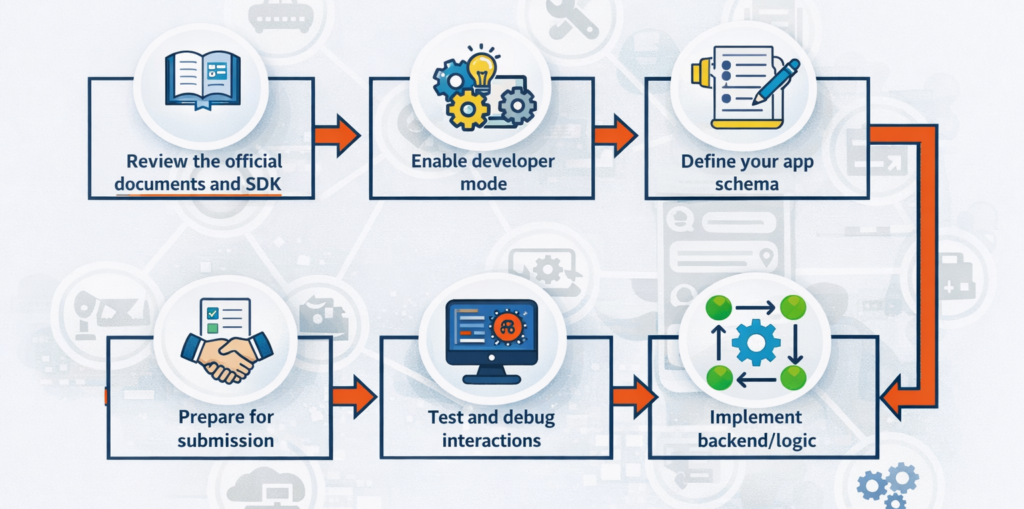
Submitting an app to ChatGPT involves more than just building functionality—it requires designing a conversation-native experience that integrates seamlessly with OpenAI’s platform. Below is a step-by-step overview of how developers can submit their app to the ChatGPT App Directory.
Step 1: Create and Verify an OpenAI Developer Account
To begin, developers must have an active and verified account on the OpenAI Platform. Verification ensures compliance with OpenAI’s identity and usage requirements and enables access to developer tools, APIs, and the Apps submission dashboard.
Step 2: Build the App Using OpenAI’s Apps Framework
GPT apps are built using OpenAI’s supported integration methods, including the Apps SDK and approved APIs. These apps are designed to respond to conversational prompts and perform actions such as fetching data, executing workflows, or interacting with external services. Developers should ensure that the app is reliable, context-aware, and optimized for natural language interaction.
Step 3: Test the App Thoroughly
Before submission, developers should test the app extensively to confirm:
- Correct handling of user inputs
- Stable performance across conversation flows
- Graceful error handling
- Accurate and relevant responses
Testing helps reduce review delays and improves the chances of approval.
Step 4: Prepare App Metadata
Each submission requires clear and complete metadata, including:
- App name and short description
- Detailed explanation of functionality
- Category selection (e.g., productivity, research, education)
- App icon and branding assets
- Supported regions and languages
- Link to a valid privacy policy
Well-written metadata improves discoverability within the App Directory.
Step 5: Submit via the OpenAI Platform
Once ready, developers can submit the app through the App Submission section of the OpenAI developer dashboard. After submission, the app enters a review queue, and developers can track its status directly from the platform.
Step 6: Review Feedback and Approval
OpenAI may request changes or clarifications during the review process. Once approved, the app becomes publicly available in the ChatGPT App Directory, where users can discover and enable it directly within ChatGPT.
Submission Requirements: Safety, Privacy & Policies
To maintain trust and platform integrity, OpenAI enforces strict safety, privacy, and policy requirements for all ChatGPT apps. Compliance with these requirements is mandatory for approval and continued availability.
Safety and Responsible Use
Apps must comply with OpenAI’s usage policies and should not enable harmful, deceptive, or illegal activities. Developers are expected to design safeguards that prevent misuse and ensure that the app behaves responsibly across a wide range of user inputs.
Privacy and Data Handling
Every submitted app must include a clear and accessible privacy policy explaining:
- What user data is accessed
- Why the data is needed
- How the data is stored, processed, or shared
Apps should request only the minimum data required to function and must respect user consent. Users must be able to disconnect an app at any time, immediately revoking its access to their data.
Transparency and User Control
Apps should clearly communicate their capabilities and limitations. Misleading descriptions, hidden data usage, or unclear functionality can result in rejection. Transparency builds user trust and is a core requirement of the GPT App ecosystem.
Policy Compliance and Ongoing Review
Even after approval, apps remain subject to ongoing monitoring. OpenAI reserves the right to review, restrict, or remove apps that violate policies, fail to maintain security standards, or negatively impact user experience.
What Happens After Submission
Once a developer submits an app to ChatGPT through the OpenAI platform, the app enters a review and validation process designed to ensure quality, safety, and reliability. During this phase, OpenAI evaluates the app’s functionality, metadata accuracy, policy compliance, privacy practices, and overall user experience. The review process focuses on whether the app behaves as described, respects user consent, and integrates smoothly within the ChatGPT conversational flow.
If issues are identified, developers may receive feedback requesting clarifications or changes. These can include adjustments to app descriptions, improvements in error handling, or stronger transparency around data usage. Developers can revise and resubmit their apps without starting the process from scratch. Once approved, the app is published in the ChatGPT App Directory, making it discoverable to users directly inside ChatGPT.
After publication, apps may be surfaced organically through search, category browsing, or contextual suggestions during conversations. OpenAI may also monitor app performance and user feedback over time. Apps that fail to maintain policy compliance or negatively affect user experience may be restricted, updated, or removed, ensuring long-term ecosystem quality.
Monetization & Future Opportunities
At present, OpenAI’s GPT App platform is primarily focused on ecosystem growth rather than immediate monetization. Direct in-chat payment systems are still evolving, and many apps currently monetize externally—by linking to subscription services, SaaS platforms, APIs, or business offerings outside ChatGPT. This approach allows developers to leverage ChatGPT as a distribution and engagement channel rather than a standalone revenue engine.
However, OpenAI has indicated that it is actively exploring future monetization models. These may include paid app access, revenue sharing, in-chat purchases, or subscription-based GPT services. As the platform matures, developers who establish early presence and strong user adoption are likely to benefit from these opportunities when monetization features are introduced.
Beyond revenue, GPT apps also offer long-term strategic value. Developers can validate ideas quickly, gain feedback from a large user base, and position their products within an emerging AI-native marketplace. For startups and research teams, this creates opportunities for visibility, partnerships, and product evolution driven directly by conversational usage patterns.
Why This Matters for Developers and Users
For developers, the ability to submit apps to ChatGPT represents a fundamental shift in how software can be distributed and used. Instead of building separate interfaces, developers can deliver functionality directly through natural language. This lowers adoption barriers, shortens user onboarding, and enables faster iteration based on real conversational interactions. The GPT App ecosystem also opens access to a global audience already engaged with AI-powered workflows.
For users, GPT apps transform ChatGPT from a question-answering tool into a do-everything interface. Users can research, plan, analyze, and act within a single conversational environment—without switching between multiple applications. This results in smoother workflows, reduced cognitive load, and more personalized digital experiences.
At a broader level, the GPT App platform signals the rise of AI as an application layer, where intelligence and functionality converge. By enabling developers to embed real services into conversations, OpenAI is redefining how people interact with software—making AI not just an assistant, but a gateway to action.