Industry 4.0 refers to the current phase of industrial transformation where traditional industries become smarter, more connected, and more responsive through digital technologies. Instead of machines working in isolation or following fixed instructions, Industry 4.0 enables machines, systems, and people to communicate, analyze data, and make decisions together in real time.
At the heart of Industry 4.0 is the idea of connected intelligence. Sensors collect data from machines, production lines, and environments; software analyzes this data using analytics and artificial intelligence; and the system uses these insights to improve efficiency, quality, and flexibility. This allows factories to predict failures before they happen, adapt production to changing demands, and reduce waste without constant human intervention.
More importantly, Industry 4.0 is not about replacing humans with machines. It is about augmenting human capabilities. Engineers, operators, and managers gain better visibility, smarter tools, and data-driven insights that help them make faster and more informed decisions. In simple terms, Industry 4.0 turns factories and industrial systems into living, learning environments—where technology supports people in building smarter, safer, and more sustainable industries.
How Industry 4.0 Evolved: A Brief Overview
Industry 4.0 did not emerge overnight. It is the result of a long evolution in the way humans produce goods and organize industrial work. Each industrial revolution introduced new technologies that fundamentally changed productivity, labor, and society.
The First Industrial Revolution (Industry 1.0) began in the late 18th century with the introduction of mechanization powered by water and steam. Manual labor was replaced by machines, enabling large-scale production for the first time. The Second Industrial Revolution (Industry 2.0) followed with electricity, assembly lines, and mass production, making manufacturing faster, cheaper, and more standardized.
The Third Industrial Revolution (Industry 3.0) introduced electronics, computers, and basic automation. Machines could now be programmed, and industrial processes became more precise and efficient. However, systems still largely worked in isolation and relied heavily on human supervision.
Industry 4.0 represents the next step—where digital technologies connect everything. Machines are no longer just automated; they are intelligent and interconnected. By combining sensors, networks, data analytics, and artificial intelligence, Industry 4.0 enables systems that can learn, adapt, and collaborate with humans. This evolution reflects a shift from automation alone to smart, data-driven industrial ecosystems.
Core Technologies Powering Industry 4.0
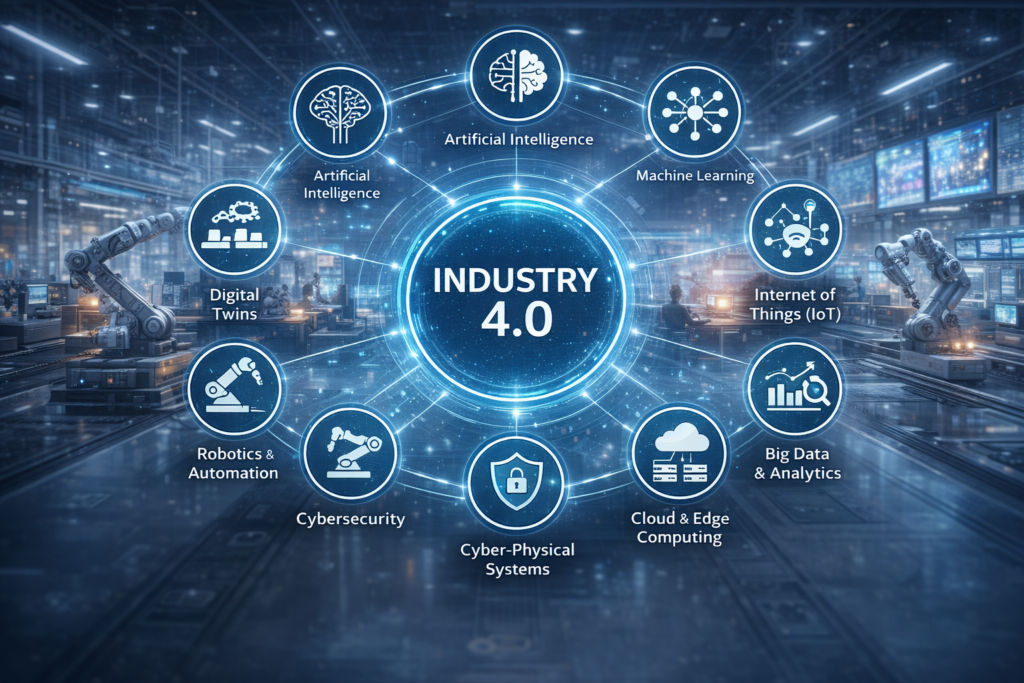
Industry 4.0 is driven by a set of digital technologies that work together to create intelligent, connected industrial systems. Each technology plays a specific role, but their real power emerges when they are integrated into a unified ecosystem.
Internet of Things (IoT) enables machines, sensors, and devices to communicate with each other by continuously collecting and sharing data from the physical world. This real-time visibility allows industries to monitor performance, track assets, and respond quickly to changing conditions.
Artificial Intelligence (AI) and Machine Learning transform raw data into actionable intelligence. These technologies help systems recognize patterns, predict equipment failures, optimize processes, and support decision-making with minimal human intervention.
Big Data and Advanced Analytics handle the massive volumes of data generated by connected systems. By analyzing historical and real-time data, organizations can improve efficiency, reduce downtime, and enhance product quality.
Cloud and Edge Computing provide the computational backbone of Industry 4.0. Cloud platforms enable scalable storage and processing, while edge computing brings intelligence closer to machines for faster, real-time responses.
Cyber-Physical Systems and Automation tightly integrate physical processes with digital control systems, allowing machines to react dynamically to their environment. Together, these technologies form the foundation of smart factories and intelligent industrial operations.
Smart Factories and Connected Manufacturing
One of the most visible outcomes of Industry 4.0 is the rise of smart factories—production environments where machines, systems, and people are digitally connected. In a smart factory, equipment is no longer isolated; every machine continuously shares data about its status, performance, and environment, creating a transparent and responsive manufacturing ecosystem.
Connected manufacturing allows production systems to adapt in real time. If a machine shows signs of failure, the system can schedule maintenance before a breakdown occurs. If customer demand changes, production parameters can be adjusted automatically without stopping the entire line. This flexibility makes manufacturing more efficient, resilient, and cost-effective.
Equally important is the role of humans within smart factories. Operators and engineers are supported by dashboards, analytics, and intelligent alerts that help them make informed decisions quickly. Rather than replacing workers, Industry 4.0 enhances human expertise—turning factories into collaborative environments where technology and people work together to deliver higher quality, customized, and sustainable products.
Role of AI, IoT, and Data in Industry 4.0
AI, IoT, and data form the core intelligence loop of Industry 4.0. IoT devices act as the senses of the system, continuously capturing data from machines, production lines, supply chains, and the surrounding environment. This data includes everything from temperature and vibration to energy usage and production speed, creating a real-time picture of industrial operations.
Artificial Intelligence and machine learning serve as the brain. They analyze incoming data to detect patterns, predict outcomes, and recommend or automate actions. For example, AI models can forecast equipment failures, optimize production schedules, and improve quality control by identifying defects that human eyes might miss.
Data acts as the connecting thread that links machines, systems, and people. When data is properly collected, analyzed, and visualized, it empowers decision-makers at every level—from shop-floor operators to senior management. In Industry 4.0, data is not just recorded; it is actively used to drive continuous improvement, agility, and innovation across industrial processes.
Human–Machine Collaboration in Modern Industry
A defining feature of Industry 4.0 is the shift from human-versus-machine to human-with-machine collaboration. Instead of fully automating processes and removing human involvement, Industry 4.0 systems are designed to support, assist, and enhance human decision-making. Machines handle repetitive, data-intensive tasks, while humans focus on creativity, judgment, and complex problem-solving.
Collaborative robots (cobots), intelligent interfaces, and decision-support systems allow workers to interact safely and effectively with advanced machinery. For example, AI-driven dashboards provide operators with insights rather than raw data, enabling faster and more informed responses. Maintenance engineers can rely on predictive analytics to plan interventions instead of reacting to breakdowns.
This collaboration also improves workplace safety and productivity. Machines can take over hazardous tasks, while humans supervise and guide operations at a higher level. In this way, Industry 4.0 reshapes the role of workers—not by replacing them, but by upskilling and empowering them to work alongside intelligent systems in more meaningful and impactful ways.
Benefits of Adopting Industry 4.0
Adopting Industry 4.0 brings significant benefits to organizations across efficiency, quality, and competitiveness. One of the most immediate advantages is improved operational efficiency. Real-time monitoring and predictive analytics reduce unplanned downtime, optimize resource usage, and streamline production workflows, leading to lower costs and higher output.
Another key benefit is enhanced product quality and customization. Smart systems can detect defects early, maintain consistent quality standards, and adapt production lines to meet specific customer requirements. This flexibility enables mass customization—producing personalized products without sacrificing efficiency.
Industry 4.0 also supports better decision-making and sustainability. Data-driven insights help leaders make informed strategic choices, reduce energy consumption, and minimize waste. By increasing transparency across the value chain, organizations can respond faster to market changes, improve resilience, and build more sustainable and future-ready industrial operations.
Challenges and Limitations of Industry 4.0
Despite its advantages, Industry 4.0 also presents several challenges that organizations must address to ensure successful adoption. One major barrier is the high initial investment required for digital infrastructure, sensors, software platforms, and skilled personnel. For small and medium-sized enterprises, these costs can be a significant hurdle.
Another challenge lies in system integration and interoperability. Many industries operate with legacy machines and software that were not designed to communicate with modern digital systems. Integrating old and new technologies into a unified, secure platform requires careful planning and technical expertise.
There is also a growing concern around data security and workforce readiness. As systems become more connected, they become more vulnerable to cyber threats. At the same time, employees must be trained to work with advanced digital tools. Without proper cybersecurity measures and continuous skill development, the full potential of Industry 4.0 cannot be realized.
Industry 4.0 Use Cases Across Sectors
Industry 4.0 is not limited to manufacturing alone; its principles and technologies are being applied across multiple sectors, reshaping how industries operate and deliver value.
In manufacturing, smart factories use predictive maintenance, real-time quality monitoring, and automated production planning to improve efficiency and reduce downtime. Digital twins allow engineers to simulate and optimize processes before making physical changes on the shop floor.
In healthcare, Industry 4.0 technologies enable connected medical devices, intelligent diagnostics, and data-driven hospital operations. IoT sensors and AI analytics help monitor patients remotely, optimize resource utilization, and improve treatment outcomes.
In logistics and supply chains, real-time tracking, intelligent warehousing, and demand forecasting improve visibility and coordination across complex networks. Similarly, in energy and agriculture, smart grids, precision farming, and sensor-based monitoring enhance sustainability and resource management. These use cases demonstrate how Industry 4.0 creates value far beyond the factory, influencing entire ecosystems.
Impact on Workforce and Skills
Industry 4.0 is significantly changing the nature of work and the skills required in modern industries. While automation reduces the need for repetitive manual tasks, it increases demand for digital, analytical, and interdisciplinary skills. Workers are expected to understand not only machines, but also data, software, and intelligent systems.
New roles are emerging, such as data analysts, AI engineers, automation specialists, and digital maintenance professionals. At the same time, traditional roles are evolving, requiring workers to interact with dashboards, interpret analytics, and collaborate with intelligent machines. This shift makes continuous learning and upskilling essential for both employees and organizations.
Importantly, Industry 4.0 does not eliminate the human role; it transforms it. Critical thinking, problem-solving, creativity, and ethical judgment remain uniquely human strengths. Organizations that invest in training, education, and human–machine collaboration are better positioned to build a resilient workforce that can thrive in an Industry 4.0 environment.
Industry 4.0 and Digital Security
As industries become more connected and data-driven, digital security becomes a critical concern in Industry 4.0. Connected machines, cloud platforms, and IoT devices expand the attack surface, making industrial systems more vulnerable to cyber threats than traditional, isolated setups. A security breach can disrupt operations, compromise sensitive data, or even cause physical damage to infrastructure.
Industry 4.0 requires a shift from basic IT security to end-to-end cybersecurity strategies that protect both digital and physical assets. This includes secure device authentication, encrypted data transmission, continuous monitoring, and real-time threat detection. Cybersecurity must be embedded into system design rather than treated as an afterthought.
Equally important is human awareness. Employees need training to recognize security risks, follow best practices, and respond appropriately to incidents. In Industry 4.0, digital security is not just a technical issue—it is an organizational responsibility that ensures trust, reliability, and long-term sustainability of smart industrial systems.
Future of Industry 4.0 and the Path to Industry 5.0
Industry 4.0 continues to evolve as technologies mature and organizations gain deeper experience with digital transformation. Future developments will focus on greater autonomy, deeper intelligence, and wider connectivity, with systems becoming more self-optimizing and adaptive. Advances in artificial intelligence, edge computing, and digital twins will further enhance real-time decision-making and operational resilience.
At the same time, a new concept—Industry 5.0—is beginning to take shape. While Industry 4.0 emphasizes efficiency and automation, Industry 5.0 places stronger focus on human-centric design, sustainability, and societal value. The goal is not just smarter factories, but systems that prioritize human well-being, environmental responsibility, and ethical use of technology.
Rather than replacing Industry 4.0, Industry 5.0 builds on its foundation. The future of industry will combine intelligent automation with human creativity and responsibility, ensuring that technological progress supports both economic growth and social good.
Why Industry 4.0 Matters Today
Industry 4.0 represents more than a technological upgrade—it marks a fundamental shift in how industries think, operate, and grow. By integrating intelligent machines, real-time data, and human expertise, Industry 4.0 enables organizations to become more agile, efficient, and resilient in an increasingly complex global environment.
For businesses, adopting Industry 4.0 is no longer optional. It is essential for staying competitive, meeting evolving customer expectations, and responding quickly to disruptions. For workers and society, it creates opportunities for smarter work, safer environments, and sustainable development—provided the transition is managed responsibly.
As industries move forward, the true value of Industry 4.0 lies in its ability to balance technology with human purpose. Those who invest not only in machines and data, but also in people, skills, and ethics, will be best positioned to lead the next era of industrial innovation.