
In an era where sustainability meets bottom-line business imperatives, a groundbreaking innovation is transforming how we manage energy in commercial buildings. Researchers at the University of Glasgow have developed a system that combines edge AI with digital twin technology to tackle one of the most persistent yet overlooked drains on corporate resources: phantom power consumption.
The Hidden Cost of “Always-On” Devices
Walk through any office building after hours, and you’ll see the telltale glow of standby lights on monitors, computers, and countless other devices. This phenomenon, known as “phantom load,” represents electricity consumed by devices in standby or idle mode—and it’s far more expensive than most organizations realize.
Recent research reveals that phantom load can account for up to 32 percent of a building’s total energy profile. In office environments specifically, roughly one-third of all electricity usage stems from devices that aren’t actively being used. For student housing, the numbers are even more striking, with standby power representing up to 33 percent of total consumption.
Dr. Ahmad Taha, Lecturer for Autonomous Systems & Connectivity at the University of Glasgow’s James Watt School of Engineering, puts it plainly: “I’m a firm believer in the idea that small, collective actions on climate issues can have big effects, and phantom power use is an obvious candidate for that kind of action.”
Why Traditional Solutions Fall Short
Many organizations have attempted to address phantom load through timer-based systems or simple on/off controls. However, these approaches often create more problems than they solve. The fundamental issue? They lack context.
A computer that appears idle might actually be running critical background processes. A monitor in standby mode might need to be instantly accessible for an employee working remotely. Binary control systems can’t distinguish between wasteful energy consumption and necessary low-power states, leading to user frustration and ultimately to employees overriding the system entirely.
What’s needed is a smarter approach—one that understands usage patterns, predicts user behavior, and makes intelligent decisions in real-time.
Enter Edge-Enabled Digital Twins
The solution developed by the Glasgow research team represents a fundamental shift in building management philosophy. Their Edge-Enabled Digital Twins (EEDT) system creates virtual representations of physical assets on a local edge server, where artificial intelligence analyzes data and makes autonomous decisions.
Here’s what makes this approach revolutionary:
Local Processing for Privacy and Speed
By processing data at the edge rather than sending it to the cloud, the system addresses two critical concerns. First, it eliminates privacy risks associated with monitoring individual usage patterns—a significant consideration in today’s data-conscious environment. Second, it ensures the low latency required for real-time control decisions.
Fuzzy Logic Instead of Binary Rules
Rather than simple on/off switches, the EEDT system employs “fuzzy logic”—a computing approach based on degrees of truth rather than absolute true/false conditions. The system draws data from smart energy sensors communicating via LoRaWAN protocol and calculates three key metrics:
- User Habit Score: Analyzes usage patterns and behavioral routines to predict when devices are genuinely needed
- Device Activity Score: Integrates standby duration and recent activity to assess current device status
- Confidence Score: Evaluates data reliability to prevent acting on incomplete information
Based on these inputs, the digital twin can make nuanced decisions: immediate shutdown, delayed action, user notification, or maintaining current state.
Intelligent User Engagement
When the system detects prolonged idle periods, it doesn’t simply cut power. Instead, it prompts users to confirm whether they’re conducting remote work or running background processes. This approach raises awareness about energy waste while preventing legitimate work from being interrupted.
The Financial Case: Real Results from Real Deployment
The researchers validated their system through deployment in a university research laboratory. The results provide a compelling business case for adoption:
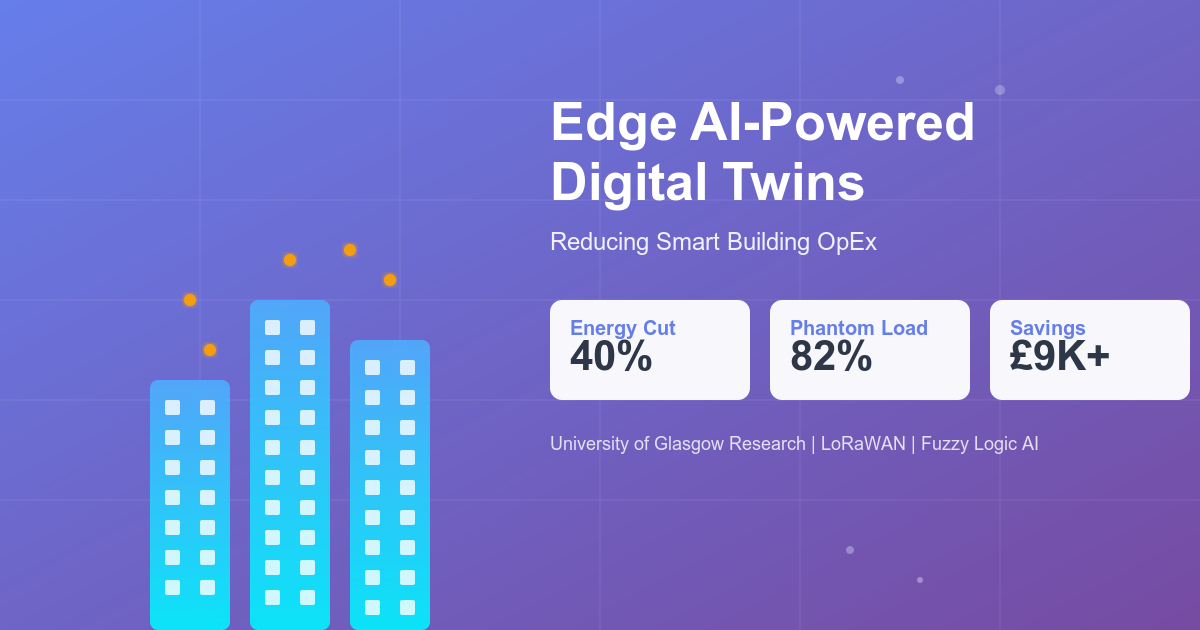
- 40.14% reduction in weekly power consumption per monitored workstation
- 82% reduction in phantom loads specifically
- Over £9,000 in annual savings projected for a 500-device deployment (based on UK electricity prices as of July 2025)
But the benefits extend beyond immediate energy savings. Dr. Taha notes an additional advantage: “By reducing devices’ use of electricity, it could help reduce the need to replace older devices with newer, more power-efficient ones. That in turn could help organizations save on equipment costs in an increasingly challenging economic environment.”
The Technical Architecture
For IT and facilities teams considering implementation, the system’s technical stack is both robust and flexible. The researchers utilized:
- Docker containers for deployment
- MQTT broker for messaging
- Node-RED for data parsing
- InfluxDB for time-series data storage
This containerized edge architecture enables “closed-loop” control, where the digital twin doesn’t just monitor but actively intervenes in the physical world.
A critical component is the Anti-Oscillation Filter, which prevents the rapid on/off switching that plagued earlier automated systems. Through cooldown management and stability checks, the system ensures that shutdown decisions are contextually appropriate and stable.
The system also incorporates Long Short-Term Memory (LSTM) deep learning for forecasting. Trained on just two days of historical data, the model can predict the next day’s consumption trends, allowing facilities teams to anticipate peak loads rather than merely reacting to them.
Scalability and Future Directions
While the study focused on a university setting, the architecture transfers directly to corporate offices, healthcare facilities, and industrial environments. The University of Glasgow is currently investigating how this tool can contribute to achieving their net-zero target by 2030, expanding the system to monitor additional variables like occupancy and temperature control.
However, scaling does present challenges. The current system relies on 27 manually designed fuzzy rules, which may limit rapid deployment across diverse asset types. Future enterprise-grade solutions will likely need to incorporate neuro-fuzzy learning to automate rule generation based on specific departmental behaviors.
The Path Forward
The transition from passive energy monitoring to edge AI-driven optimization represents the next necessary evolution for smart buildings. As Dr. Taha emphasizes, “Reaching net-zero will require a broad-spectrum approach to energy monitoring, and this tool could be a valuable part of wider institutional approaches to minimizing their carbon footprint.”
For business leaders, the message is clear: the technology to dramatically reduce operational expenses while advancing sustainability goals already exists. The data flows through your building’s networks right now. The challenge isn’t gathering that data—it’s empowering edge assets with artificial intelligence to act on it intelligently.
In a world where every kilowatt-hour counts—both for the environment and the balance sheet—edge AI-powered digital twins aren’t just making buildings smarter. They’re making them truly intelligent.
