
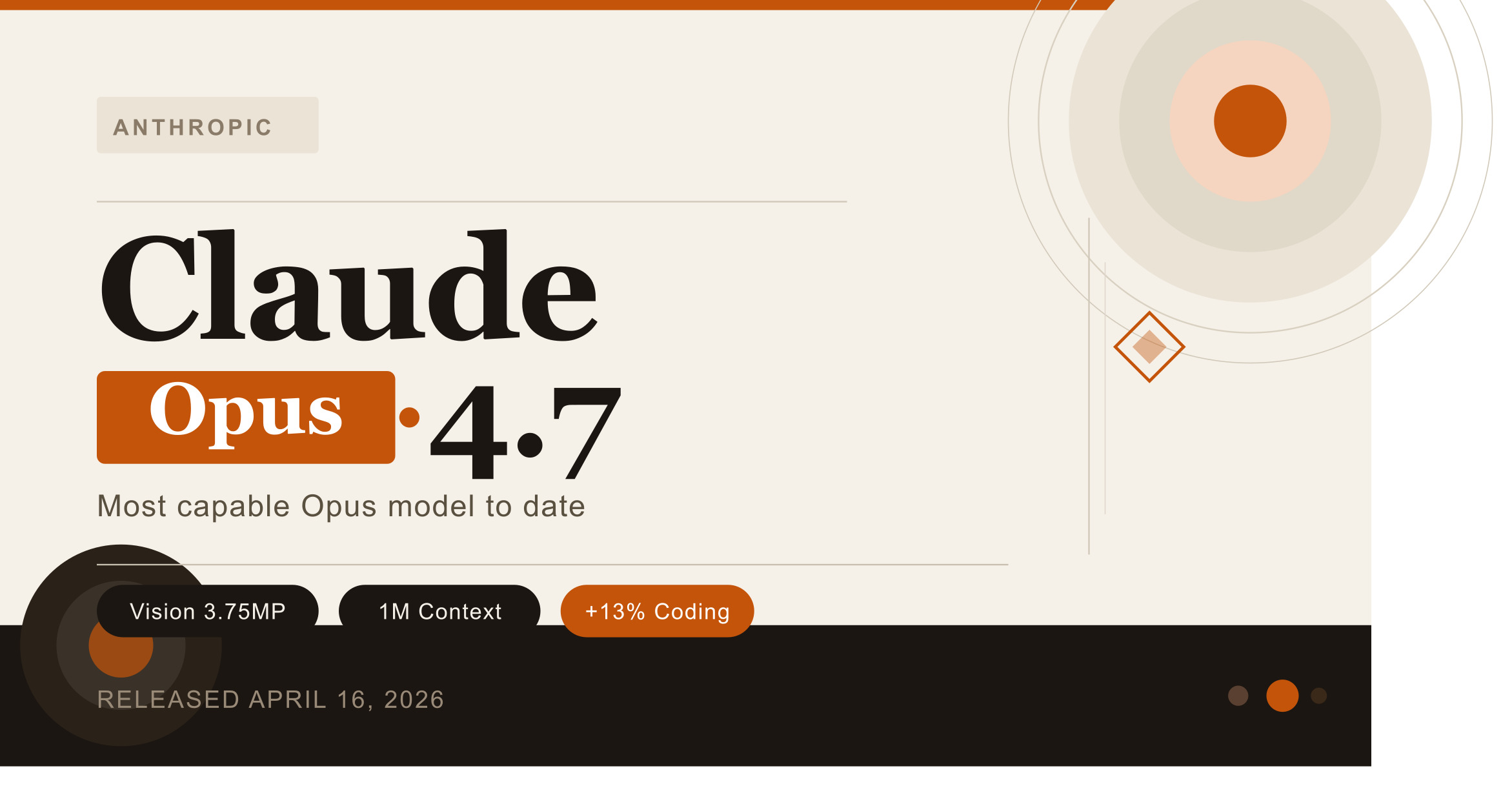
When Anthropic dropped Claude Opus 4.6 in February, developers barely had time to settle in before the next upgrade arrived. On April 16, 2026, Claude Opus 4.7 became generally available — and if 4.6 was the workhorse, 4.7 is the thoroughbred.
The new model builds on its predecessor’s foundation with targeted, meaningful improvements: a significant leap in agentic coding, high-resolution vision for the first time in the Opus line, a novel task-budget feature for developers, and behavioral refinements that make Claude more literal, more honest about its limits, and more reliable over long, multi-step sessions.
This is not a ground-up rewrite. Anthropic describes it as a “careful tune-up” — but in practice, the cumulative effect across benchmark performance, user feedback, and new API capabilities is substantial. Here’s everything you need to know.
By the Numbers
- +13% coding task resolution vs Opus 4.6
- 3.75MP max image resolution (new)
- 1 million token context window
What’s Actually New
1. Better Coding, Full Stop
The headline improvement is software engineering. Opus 4.7 is a notable step up from 4.6 on advanced coding tasks — particularly the hardest ones that previously required close human supervision. The model now catches its own logical faults during the planning phase, verifies its outputs before reporting back, and sustains performance over long-running, multi-session workflows.
Early testers back this up with hard numbers. One platform running an internal 93-task coding benchmark saw a 13% lift in resolution rates over 4.6 — including four tasks that neither Opus 4.6 nor Sonnet 4.6 could complete at all. The model also came in with faster median latency and stricter instruction following.
“It catches its own logical faults during the planning phase and accelerates execution, far beyond previous Claude models.” — Enterprise early-access tester (financial technology platform)
2. High-Resolution Vision — A First for Opus
Opus 4.7 is the first Claude model to support high-resolution images. Maximum image resolution has jumped to 2576px / 3.75 megapixels, up from the previous ceiling of 1568px / 1.15MP — a more than 3× increase in pixel density.
In practice, this means Claude can now meaningfully parse fine-grained charts, dense document scans, and complex screen UIs where small details carry real information. For teams using Claude in document processing pipelines or building visual analysis tools, this is a quiet but significant upgrade.
3. Task Budgets: Giving Claude a Token Countdown
This is the most interesting developer feature in the release. Task budgets give Claude a rough token target for an entire agentic loop — including thinking, tool calls, results, and final output. The model tracks a running countdown and adjusts its behavior accordingly, prioritizing work and wrapping up gracefully as the budget runs low.
It’s designed for developers building long-horizon agents who want predictable, bounded runs rather than unconstrained token sprawl. The feature is available via the beta header task-budgets-2026-03-13 in the API.
Developer heads-up: If you’re using /v1/messages/count_tokens for cost estimation, note it will return different counts for Opus 4.7 than 4.6 due to the new tokenizer. Review your token budgets before migrating.
4. A New Tokenizer
Opus 4.7 ships with a new tokenizer that contributes to its performance gains. The same text may now cost roughly 1× to 1.35× as many tokens — up to 35% more, depending on content. Pricing per token is unchanged at $5/$25 per million input/output tokens, so real-world costs could rise meaningfully for some workloads.
5. Thinking Is Now Hidden by Default
Starting with Opus 4.7, thinking content is omitted from the response stream by default. Reasoning still happens internally, but the blocks that previously streamed to users will appear empty unless you explicitly opt in. This is a silent change — no error is raised — and response latency will improve slightly. If your product shows Claude’s reasoning to users, you’ll notice a long pause before output begins. Opt back in by setting “display”: “summarized” in your output config.
What’s Better (But Not New)
Beyond the headline features, Anthropic describes a range of behavioral improvements felt clearly in practice:
- Strict instruction following — The model no longer silently generalizes instructions from one item to another. It follows what you wrote, not what it thinks you probably meant.
- Better data honesty — Correctly reports when data is missing rather than providing plausible-but-incorrect fallbacks. It resists “dissonant data traps” that caught Opus 4.6 out.
- File-system memory — Long, multi-session agentic workflows behave more reliably. File-based memory across sessions feels like a first-class feature, not a workaround.
- Better professional output — More tasteful and creative results when producing interfaces, slides, and documents. The model’s aesthetic judgment has improved noticeably.
Safety and Cybersecurity Controls
Anthropic used the Opus 4.7 launch to test new cybersecurity safeguards ahead of a potential broader release of its more powerful Claude Mythos model. Opus 4.7’s cyber capabilities are intentionally less advanced than Mythos Preview, and the release ships with automated detection and blocking for prohibited cybersecurity uses.
Security professionals doing legitimate work — vulnerability research, penetration testing, red-teaming — are invited to apply to Anthropic’s new Cyber Verification Program to get access without hitting these guardrails.
Pricing and Availability
Pricing is unchanged from Opus 4.6:
- Input tokens: $5 per million
- Output tokens: $25 per million
- Context window: 1 million tokens (128k max output)
Available today across Claude.ai, the Anthropic API (model ID: claude-opus-4-7), Amazon Bedrock, Google Cloud Vertex AI, Microsoft Foundry, Snowflake Cortex, and GitHub Copilot.
Claude Opus 4.7 is a focused, deliberate improvement over 4.6 — not a generational leap, but a meaningful one. If you’re doing serious agentic coding, long-horizon research, or visual document analysis, the upgrade is worth it. The new task-budget feature alone will change how developers architect Claude-powered workflows.
The hidden-thinking default and strict instruction following are behavioral shifts that require attention before you migrate. And keep an eye on your token costs — the new tokenizer may add up to 35% more tokens per prompt. Test before you assume parity with your 4.6 budget.
Opus 4.7 positions Anthropic well as they inch toward a broader rollout of Mythos-class capabilities. This release is as much a safety proving ground as it is a product update — and that, perhaps, is the most interesting part of the story.

