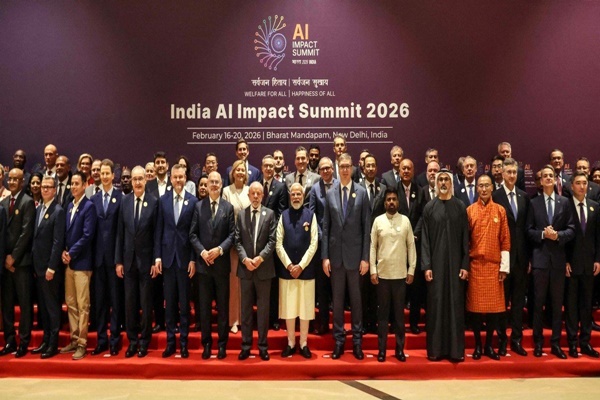
India AI Summit 2026 is widely used as a short name for the India AI Impact Summit 2026, hosted in New Delhi under the Government of India’s IndiaAI Mission. The summit drew attention because it focused on “AI with impact”—real deployments, real outcomes, and global cooperation. It also became a global talking point because the summit week ended with the New Delhi Declaration on AI Impact, a shared international framework aimed at inclusive and responsible AI.
The summit programme is described officially as a five-day event (16–20 February 2026) at Bharat Mandapam, New Delhi. Separately, the Ministry of External Affairs describes the high-level Summit segment as being held on 18–19 February 2026, when the New Delhi Declaration was adopted.You may also see public announcements that highlight 19–20 February as “Summit days,” because different parts of the programme (policy tracks, expo, challenges, closing sessions) were promoted under slightly different schedules.
The reason this summit drew wide attention is that it positioned India not only as a large market for AI, but as a convenor shaping how AI should be deployed responsibly and at scale. The official framing placed the summit on three pillars (called “sutras”)—People, Planet, and Progress—to keep the conversation focused on measurable public value rather than hype. In parallel, the event was designed to connect policy discussions with “on-ground” adoption through exhibitions, challenges, and industry participation.
A major public-facing part of the week was the India AI Impact Expo, scheduled 16–20 February 2026 (10am–6pm) at Bharat Mandapam. The expo positioning was clear: bring real solutions and deployable demos into the same venue where regulators, ministries, enterprises, startups, and researchers were already present—so collaboration can move faster than typical conference networking.
The summit’s most important formal outcome was the New Delhi Declaration on AI Impact. Official documents describe it as a shared framework for global cooperation and practical deliverables (not just principles), organised around seven “chakras” (pillars of action) such as democratizing AI resources, enabling economic growth and social good, building safe/trusted AI, human capital, AI for science, inclusion/social empowerment, and resilience/efficiency. The declaration also references collaborative mechanisms and commons-style platforms intended to support shared progress across countries.
What is notable is how the declaration’s endorsement count evolved after the summit week. PIB’s update on 24 February 2026 states that more countries joined after the initial announcement, bringing the total to 91 signatories (countries and organisations). News coverage during the summit week also reported the endorsement numbers moving upward as more delegations signed on.
In terms of scale, the Government’s post-summit release described it as one of the largest global AI gatherings, reporting over 5 lakh participants, representation from 118 countries, and participation by over 20 heads of government (and other senior representatives). Reuters coverage, however, also captured the operational reality of running an event of that scale, noting that the opening day (16 February 2026) faced logistical issues like long queues and confusion for some attendees, which became part of the public discussion alongside the summit’s policy ambitions.
The summit also generated attention around ecosystem momentum—announcements, partnerships, and “AI impact” storytelling across sectors. Separate reporting linked the summit’s momentum to continued conversations in industry forums right after the event, indicating that the summit acted as a catalyst for follow-on debates about implementation and real adoption in India.
One practical note for attendees and followers came immediately after: the IndiaAI Mission issued a scam/phishing warning aimed at summit participants, cautioning people against fraudulent messages asking for sensitive financial details. This is an important reminder that whenever large tech events happen, scammers often target the attendee lists—so basic cyber hygiene becomes part of the “AI ecosystem” story too.
Overall, the Indian AI Summit 2026 narrative is best understood as a blend of global positioning + governance outcomes + ecosystem building. The New Delhi Declaration tried to formalize cooperation around access, trust, skills, and impact; the expo showcased use-cases and industry readiness; and the scale signaled India’s intent to be central in how AI gets deployed in the real world. If you’re writing this as a WordPress blog post, a strong closing angle is: the summit wasn’t the finish line—rather, it set expectations that the next phase of India’s AI story will be judged by deployments, safeguards, and outcomes, not announcements.