
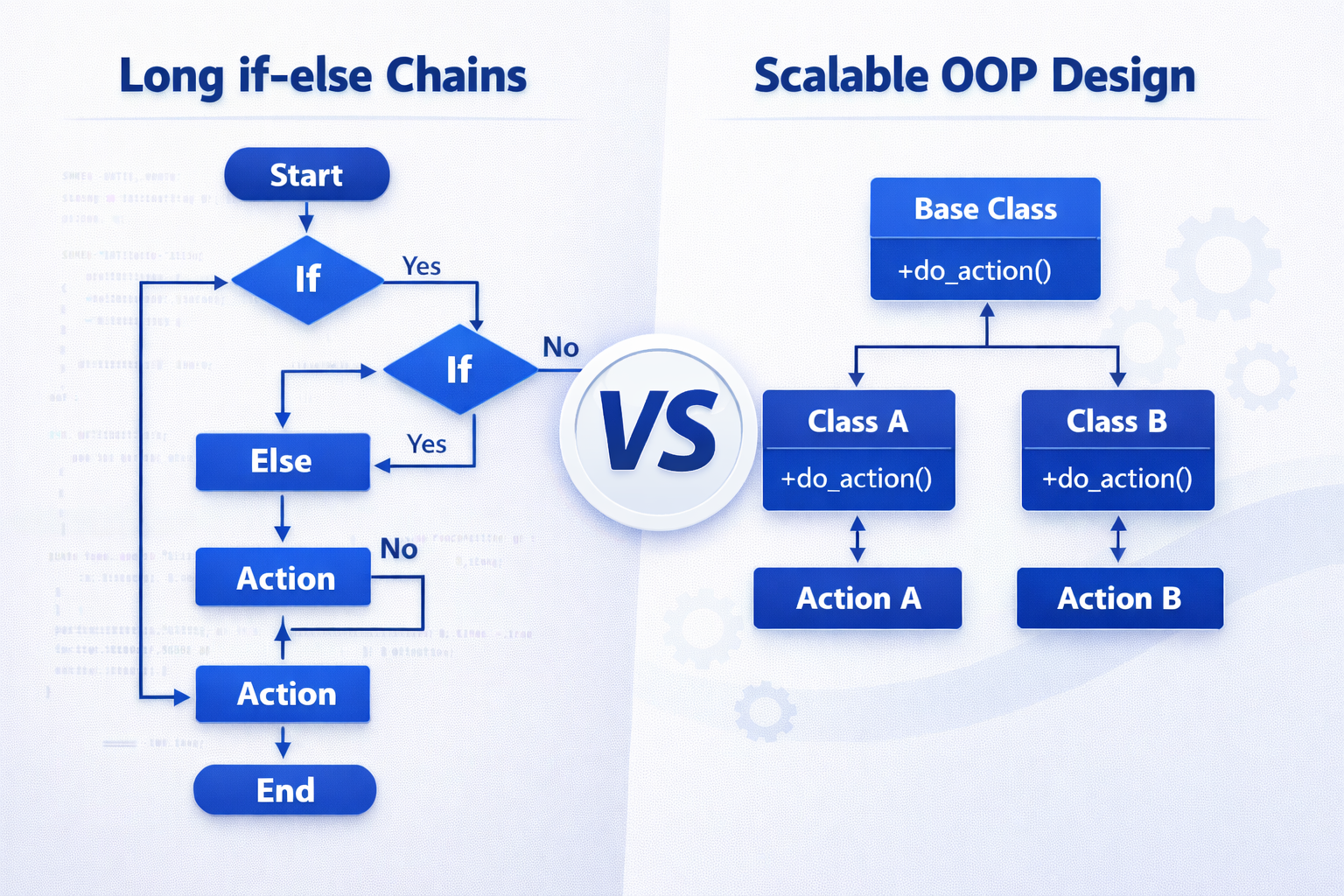
In programming, the if-else statement is one of the first tools developers learn to make decisions in code. It is simple, direct, and extremely useful for handling small conditions such as checking user input, validating data, or choosing between two or three clear actions. In the early stages of a program, using if-else often feels natural because it solves the problem quickly and keeps the logic easy to see.
The problem begins when software grows. A few conditions gradually turn into many, and over time a simple decision block can become a long chain of if, else if, and else statements. This usually happens in real projects when new features are added one by one, new business rules are introduced, or different user roles, statuses, and cases must be handled. What started as a small and practical piece of logic can slowly become a large structure that is difficult to read and even harder to change safely.
Long if-else chains create several challenges in software development. They reduce readability, make debugging harder, increase the chance of logical mistakes, and often lead to repeated code in multiple branches. When one new condition requires editing an already complex block, developers may fear breaking existing behavior. As a result, the code becomes less maintainable and less scalable, especially in projects that need frequent updates.
This does not mean that if-else is bad. In fact, it remains a very important and necessary part of programming. The real issue is not the use of if-else itself, but its overuse in situations where the design has outgrown simple branching. In such cases, developers often need better ways to organize behavior, such as functions, lookup tables, object-oriented design, or design patterns like Strategy and State.
In this article, we will explore why long if-else chains become a problem, how they affect code quality and team productivity, and what better alternatives are commonly used in scalable software development.
When if-else is useful
The if-else statement is one of the most practical and necessary tools in programming. It is useful whenever a program needs to make a clear decision based on a condition. For example, a login system may check whether a username and password are correct, a form may verify whether a required field is empty, or a program may decide whether a number is positive or negative. In such cases, if-else keeps the logic simple and easy to understand. It expresses a direct rule: if something is true, do one thing; otherwise, do another.
In small and local situations, if-else is often the best choice because it is straightforward and readable. A short decision block is easy to write, easy to debug, and easy for another developer to understand. There is no need to introduce extra classes, patterns, or complex abstractions when the problem itself is small. In fact, good software design does not mean avoiding if-else completely. It means using it where it fits naturally and keeping the logic limited to a size that remains clear.
If-else is especially useful for validation, error handling, boundary checks, and small one-time decisions. For instance, a program may check whether a file exists before opening it, whether a user has entered a valid age, or whether a value is null before processing it. These are simple control decisions, and writing them with if-else is both normal and efficient. Problems usually begin only when a small decision block grows into a long chain that tries to manage many different cases, rules, and behaviors all at once.
What is a long if-else chain
A long if-else chain is a decision structure in which a program checks many conditions one after another in a single block of code. Instead of making one or two simple decisions, the code starts handling many categories, cases, roles, states, or business rules within the same section. A block that begins as a small conditional can gradually grow into ten or twenty branches, especially in software that evolves over time. As this happens, the logic becomes harder to read because the developer must scan many conditions before understanding what the code is actually doing.
In many real-world programs, long if-else chains appear when the software needs to behave differently for different types of users, products, statuses, or actions. For example, an e-commerce system may apply different rules for regular customers, premium customers, wholesale buyers, and administrators. A school management system may show different actions for students, teachers, accountants, and department heads. At first, adding a new else-if branch may seem like a quick solution. But after repeated additions, the code becomes crowded, and all the decision-making gets packed into one place.
A long if-else chain may also include deep nesting, where one condition contains another condition, and that inner condition contains yet another one. This makes the structure even more difficult to follow because the reader must keep track of multiple decision paths at the same time. Such code often mixes checking, processing, and output together, which makes it less organized. The problem is not just the number of if and else statements. The real issue is that too much responsibility is placed inside one block, making the code difficult to extend, test, and maintain.
Why developers often end up writing long if-else chains
Developers usually do not create long if-else chains because they want bad code. Most of the time, such code grows naturally during the development process. A programmer begins with a small and valid condition, then a new requirement appears, so another branch is added. Later, another feature is introduced, another case must be handled, and another special rule is inserted. Over time, what started as a small solution becomes a large chain of conditions. This happens very often in real software projects because software changes continuously.
One major reason is speed. When developers are under pressure to deliver features quickly, adding one more if or else-if often feels faster than redesigning the structure properly. In the short term, this approach seems practical because it solves the immediate problem. However, repeated quick fixes slowly create a block of code that becomes difficult to manage. What was once a temporary solution turns into a permanent part of the system. This is common in business applications where rules change frequently, such as billing systems, admission systems, workflow management, and access control.
Another reason is that the full scope of the software is rarely known at the beginning. A developer may initially think there will be only two or three cases, so using if-else seems completely reasonable. Later, the software expands and supports many more cases than expected. Because the original code was not designed for that growth, the easiest path becomes adding more conditions rather than restructuring the design. Legacy systems also contribute to this problem. When developers inherit older code, they often continue the existing style instead of refactoring it, especially when they fear breaking working functionality. As a result, long if-else chains become a common outcome of gradual software growth, time pressure, and evolving requirements.
Why Long if-else Chains Become a Problem
A few if-else statements are perfectly normal in programming. They help a program make decisions clearly and directly. The problem begins when the same block keeps growing as new cases are added. Over time, a simple decision structure can turn into a long chain of conditions that becomes difficult to read, difficult to change, and risky to maintain. This section explains the main problems caused by long if-else chains, along with simple examples.
- Readability Becomes Poor
When a conditional block becomes too long, the code stops being easy to understand. A reader must go through many branches before knowing what the program really does. This slows down development because every new developer, or even the original developer after some time, must spend extra effort understanding the flow.
if role == "student":
    print("Show student dashboard")
elif role == "teacher":
    print("Show teacher dashboard")
elif role == "hod":
    print("Show HOD dashboard")
elif role == "dean":
    print("Show dean dashboard")
elif role == "registrar":
    print("Show registrar dashboard")
elif role == "admin":
    print("Show admin dashboard")
else:
    print("Show guest page")
This code is still understandable, but as more roles are added, the structure becomes crowded. A simple task such as adding one more role means returning to the same block and extending it again.
- Maintenance Becomes Difficult
Long if-else chains are hard to maintain because every new requirement usually forces the developer to modify existing code. This increases the risk of breaking something that already works. A small change may affect the order of conditions or make one branch behave differently from before.
if marks >= 90:
    grade = "A"
elif marks >= 80:
    grade = "B"
elif marks >= 70:
    grade = "C"
elif marks >= 60:
    grade = "D"
else:
    grade = "F"
Now suppose the institution introduces a new grade called A+ for marks above 95. The developer has to reopen the old logic and insert the new rule in the correct position.
if marks >= 95:
    grade = "A+"
elif marks >= 90:
    grade = "A"
elif marks >= 80:
    grade = "B"
elif marks >= 70:
    grade = "C"
elif marks >= 60:
    grade = "D"
else:
    grade = "F"
This change looks small, but repeated changes like this over time make the code fragile.
- Debugging Becomes Harder
When the output is wrong, debugging a long if-else chain can be frustrating. The developer must figure out which condition matched, why it matched, and whether another condition should have matched first. In a large decision structure, this is not always obvious.
age = 17

if age > 18:
    print("Adult")
elif age > 15:
    print("Teenager")
elif age > 12:
    print("Young Teen")
else:
    print("Child")
This code works, but imagine the conditions are more complex and involve many variables. Then it becomes harder to trace why a particular branch executed. If the order of conditions is wrong, the result may also be wrong.
- Wrong Ordering Can Cause Logical Errors
In long if-else chains, the order of conditions matters a lot. A more general condition placed above a more specific condition can make the specific case unreachable.
score = 95

if score >= 60:
    print("Passed")
elif score >= 90:
    print("Excellent")
else:
    print("Failed")
Output:
Passed
This is logically wrong because a score of 95 should be classified as Excellent. The problem is that the broader condition score >= 60 comes first, so the later branch is never reached.
Correct version:
if score >= 90:
    print("Excellent")
elif score >= 60:
    print("Passed")
else:
    print("Failed")
In long conditional chains, such ordering mistakes become much easier to make.
- Testing Effort Increases
Every new branch adds another path that must be tested. When one function contains many if-else conditions, the number of possible outcomes increases. This means testers and developers must write more test cases to ensure the logic works correctly
if user_type == "student" and fee_paid:
    print("Allow exam form")
elif user_type == "student" and not fee_paid:
    print("Block exam form")
elif user_type == "teacher":
    print("Teacher access")
elif user_type == "admin":
    print("Full access")
else:
    print("Limited access")
This code may look manageable, but it already requires several test cases:
student with fee paid, student without fee paid, teacher, admin, and others. As more conditions are added, the test combinations grow quickly.
- Code Duplication Starts Appearing
Long if-else chains often repeat similar code in different branches. This duplication makes the program harder to improve because the same change may have to be made in several places.
if payment_mode == "cash":
    total = amount + 0
    print("Generate receipt")
elif payment_mode == "card":
    total = amount + 10
    print("Generate receipt")
elif payment_mode == "upi":
    total = amount + 5
    print("Generate receipt")
else:
    print("Invalid payment mode")
Here, the statement print(“Generate receipt”) is repeated in multiple branches. As the code grows, such repetition becomes common. Repeated code increases the chance that one branch gets updated while another is forgotten.
- Nesting Makes the Code Even More Confusing
The problem becomes worse when if-else blocks are nested inside one another. Deep nesting forces the reader to mentally track multiple levels of logic at once.
if user is not None:
    if user.is_active:
        if user.has_permission:
            print("Access granted")
        else:
            print("Permission denied")
    else:
        print("Inactive user")
else:
    print("No user found")
This code is not very long, but it already feels heavier than necessary because of the nested structure. In real projects, nested conditions often become much larger and harder to follow.
- It Becomes Hard to Extend the System
Long if-else chains make extension difficult because adding a new feature usually means editing the same old decision block again. This is the opposite of scalable design. In scalable systems, developers prefer designs where a new case can be added with minimal changes to old code.
if notification_type == "email":
    send_email()
elif notification_type == "sms":
    send_sms()
elif notification_type == "push":
    send_push()
else:
    print("Unknown notification type")
Today there may be three notification types. Tomorrow the company may add WhatsApp, voice call, Telegram, or in-app messages. The same block keeps growing, and the code becomes harder to manage.
- Business Logic Gets Mixed Together
A long if-else chain often starts doing too many things at once. It may check conditions, create objects, calculate values, and print or return results all inside one block. This reduces modularity and makes the code less clean.
if customer_type == "regular":
    discount = 5
    final_amount = amount - discount
    print("Regular customer bill generated")
elif customer_type == "premium":
    discount = 15
    final_amount = amount - discount
    print("Premium customer bill generated")
elif customer_type == "vip":
    discount = 25
    final_amount = amount - discount
    print("VIP customer bill generated")
else:
    discount = 0
    final_amount = amount
    print("Normal bill generated")
This one block is deciding customer category, calculating discount, computing the final amount, and generating output. When code like this grows, it becomes difficult to separate responsibilities.
- Real Software Projects Outgrow Such Structures
In small student programs, long if-else chains may still be manageable. But in real-world systems such as admission portals, billing systems, role-based dashboards, workflow systems, and payment platforms, the number of cases grows continuously. What looked simple in the beginning becomes a maintenance burden later. That is why industrial software development gradually moves toward better structures such as functions, mappings, strategy objects, state objects, and configuration-based rules.
Real-World Scenarios with if-else Version and OOP Solution Version
Below, each scenario is shown in two forms. First, the traditional if-else approach is shown, which is often how such code begins in real projects. Then the OOP-based solution is shown, which makes the design cleaner, more scalable, and easier to maintain as the system grows.
1. User Role Handling
In many systems, different users need different dashboards or permissions. A long conditional block can handle this at first, but it becomes difficult to maintain as more roles are added.
if-else version
role = "teacher"

if role == "student":
    print("Show student dashboard")
elif role == "teacher":
    print("Show teacher dashboard")
elif role == "hod":
    print("Show HOD dashboard")
elif role == "dean":
    print("Show dean dashboard")
elif role == "admin":
    print("Show admin dashboard")
else:
    print("Show guest page")
OOP solution version
class UserRole:
    def show_dashboard(self):
        raise NotImplementedError


class StudentRole(UserRole):
    def show_dashboard(self):
        print("Show student dashboard")


class TeacherRole(UserRole):
    def show_dashboard(self):
        print("Show teacher dashboard")


class AdminRole(UserRole):
    def show_dashboard(self):
        print("Show admin dashboard")


role = TeacherRole()
role.show_dashboard()
The OOP design moves role-specific behavior into separate classes. A new role can be added without editing a large old conditional block.
2. Payment Method Processing
Payment systems often support cash, card, UPI, wallet, and bank transfer. If all methods are handled through one decision chain, the code grows quickly.
if-else version
payment_mode = "upi"
amount = 500

if payment_mode == "cash":
    print(f"Accept cash payment of {amount}")
elif payment_mode == "card":
    print(f"Process card payment of {amount}")
elif payment_mode == "upi":
    print(f"Process UPI payment of {amount}")
elif payment_mode == "wallet":
    print(f"Process wallet payment of {amount}")
else:
    print("Invalid payment mode")
OOP solution version
class PaymentStrategy:
    def pay(self, amount):
        raise NotImplementedError


class CashPayment(PaymentStrategy):
    def pay(self, amount):
        print(f"Accept cash payment of {amount}")


class CardPayment(PaymentStrategy):
    def pay(self, amount):
        print(f"Process card payment of {amount}")


class UpiPayment(PaymentStrategy):
    def pay(self, amount):
        print(f"Process UPI payment of {amount}")


class PaymentProcessor:
    def __init__(self, strategy):
        self.strategy = strategy

    def process(self, amount):
        self.strategy.pay(amount)


processor = PaymentProcessor(UpiPayment())
processor.process(500)
This is a natural use of the Strategy Pattern. The processor stays stable while payment methods remain independent.
3. Order or Workflow Status Handling
Many business systems behave differently depending on status. An order may be pending, approved, packed, shipped, or delivered.
if-else version
order_status = "shipped"

if order_status == "pending":
    print("Waiting for confirmation")
elif order_status == "approved":
    print("Prepare for packing")
elif order_status == "packed":
    print("Ready for shipping")
elif order_status == "shipped":
    print("Track delivery")
elif order_status == "delivered":
    print("Close order")
else:
    print("Unknown order status")
OOP solution version
class OrderState:
    def handle(self):
        raise NotImplementedError


class PendingState(OrderState):
    def handle(self):
        print("Waiting for confirmation")


class ShippedState(OrderState):
    def handle(self):
        print("Track delivery")


class DeliveredState(OrderState):
    def handle(self):
        print("Close order")


class Order:
    def __init__(self, state):
        self.state = state

    def process(self):
        self.state.handle()


order = Order(ShippedState())
order.process()
This is best modeled with the State Pattern because the same object behaves differently according to its current state.
4. Discount and Pricing Rules
Pricing and discount logic changes by customer type, membership level, or promotional policy. A long chain of pricing conditions becomes difficult to manage over time.
if-else version
customer_type = "vip"
amount = 1000

if customer_type == "regular":
    discount = 5
elif customer_type == "premium":
    discount = 15
elif customer_type == "vip":
    discount = 25
else:
    discount = 0

final_amount = amount - discount
print("Final amount:", final_amount)
OOP solution version
class DiscountPolicy:
    def get_discount(self, amount):
        return 0


class RegularDiscount(DiscountPolicy):
    def get_discount(self, amount):
        return 5


class PremiumDiscount(DiscountPolicy):
    def get_discount(self, amount):
        return 15


class VipDiscount(DiscountPolicy):
    def get_discount(self, amount):
        return 25


class BillingService:
    def __init__(self, discount_policy):
        self.discount_policy = discount_policy

    def generate_bill(self, amount):
        discount = self.discount_policy.get_discount(amount)
        final_amount = amount - discount
        print("Final amount:", final_amount)


service = BillingService(VipDiscount())
service.generate_bill(1000)
The OOP version separates pricing policy from billing logic. This makes rule changes safer and clearer.
5. Notification Channel Selection
Applications may send notifications through email, SMS, push notification, or WhatsApp. This is another common place where long branching appears.
if-else version
notification_type = "email"
message = "Your fee has been received."

if notification_type == "email":
    print("Sending email:", message)
elif notification_type == "sms":
    print("Sending SMS:", message)
elif notification_type == "push":
    print("Sending push notification:", message)
elif notification_type == "whatsapp":
    print("Sending WhatsApp message:", message)
else:
    print("Unsupported notification type")
OOP solution version
class NotificationChannel:
    def send(self, message):
        raise NotImplementedError


class EmailNotification(NotificationChannel):
    def send(self, message):
        print("Sending email:", message)


class SmsNotification(NotificationChannel):
    def send(self, message):
        print("Sending SMS:", message)


class PushNotification(NotificationChannel):
    def send(self, message):
        print("Sending push notification:", message)


channel = EmailNotification()
channel.send("Your fee has been received.")
Each channel becomes a focused class. The calling code no longer depends on a large condition block.
6. File Export and Report Generation
Software often allows exporting data in PDF, Excel, CSV, or JSON. As more formats are supported, the export logic becomes harder to manage through raw branching.
if-else version
file_type = "pdf"
data = {"name": "Sumant"}

if file_type == "pdf":
    print("Generate PDF report")
elif file_type == "excel":
    print("Generate Excel report")
elif file_type == "csv":
    print("Generate CSV report")
elif file_type == "json":
    print("Generate JSON output")
else:
    print("Unsupported file type")
OOP solution version
class ReportExporter:
    def export(self, data):
        raise NotImplementedError


class PdfExporter(ReportExporter):
    def export(self, data):
        print("Generate PDF report")


class ExcelExporter(ReportExporter):
    def export(self, data):
        print("Generate Excel report")


class CsvExporter(ReportExporter):
    def export(self, data):
        print("Generate CSV report")


class ExportFactory:
    @staticmethod
    def create_exporter(file_type):
        if file_type == "pdf":
            return PdfExporter()
        elif file_type == "excel":
            return ExcelExporter()
        elif file_type == "csv":
            return CsvExporter()
        else:
            raise ValueError("Unsupported format")


exporter = ExportFactory.create_exporter("pdf")
exporter.export(data)
The exporter classes handle format-specific work, while the factory centralizes creation logic.
7. Validation Rules in Forms
Admission and registration systems often require different validation rules depending on course, category, or application type.
if-else version
course = "PG"

if course == "UG":
    print("Check 10th and 12th documents")
elif course == "PG":
    print("Check graduation documents")
elif course == "PhD":
    print("Check PG degree and research proposal")
else:
    print("Unknown course type")
OOP solution version
class Validator:
    def validate(self, data):
        raise NotImplementedError


class UGValidator(Validator):
    def validate(self, data):
        print("Check 10th and 12th documents")


class PGValidator(Validator):
    def validate(self, data):
        print("Check graduation documents")


class PhDValidator(Validator):
    def validate(self, data):
        print("Check PG degree and research proposal")


validator = PGValidator()
validator.validate({})
Validation logic is cleaner when each form type owns its own rules instead of sharing one large branching block.
8. Device or Platform-Specific Behavior
Applications sometimes behave differently on Android, iOS, web, or desktop. A single platform-checking block can become messy as the product grows.
if-else version
platform = "web"

if platform == "android":
    print("Load Android settings")
elif platform == "ios":
    print("Load iOS settings")
elif platform == "web":
    print("Load web settings")
elif platform == "desktop":
    print("Load desktop settings")
else:
    print("Unknown platform")
OOP solution version
class PlatformUI:
    def load_settings(self):
        raise NotImplementedError


class AndroidUI(PlatformUI):
    def load_settings(self):
        print("Load Android settings")


class IOSUI(PlatformUI):
    def load_settings(self):
        print("Load iOS settings")


class WebUI(PlatformUI):
    def load_settings(self):
        print("Load web settings")


platform_ui = WebUI()
platform_ui.load_settings()
This structure isolates platform behavior and avoids repeated platform checks throughout the application.
9. Access Permission Checks
Permission logic becomes especially difficult when access depends on both role and action. This often leads to complicated combinations in if-else chains.
if-else version
role = "teacher"
action = "edit"

if role == "student" and action == "view":
    print("Allowed")
elif role == "student" and action == "edit":
    print("Not allowed")
elif role == "teacher" and action == "edit":
    print("Allowed")
elif role == "hod" and action == "approve":
    print("Allowed")
elif role == "admin":
    print("Allowed for all actions")
else:
    print("Access denied")
OOP solution version
class PermissionPolicy:
    def can(self, action):
        return False


class StudentPolicy(PermissionPolicy):
    def can(self, action):
        return action == "view"


class TeacherPolicy(PermissionPolicy):
    def can(self, action):
        return action in ["view", "edit"]


class AdminPolicy(PermissionPolicy):
    def can(self, action):
        return True


policy = TeacherPolicy()
print(policy.can("edit"))
Permission rules become easier to test, reuse, and extend when they are grouped into dedicated policy classes.
10. Admission and Academic Eligibility Systems
Academic systems often combine several rules at once, such as fee payment, attendance, backlog status, and category. Putting everything in one block becomes difficult to manage.
if-else version
student_type = "regular"
fee_paid = True
attendance = 80

if student_type == "regular" and fee_paid and attendance >= 75:
    print("Eligible for exam")
elif student_type == "regular" and not fee_paid:
    print("Exam form blocked due to fee pending")
elif student_type == "regular" and attendance < 75:
    print("Exam form blocked due to low attendance")
elif student_type == "backlog":
    print("Show backlog exam rules")
else:
    print("Check with administration")
OOP solution version
class EligibilityRule:
    def check(self, student):
        raise NotImplementedError


class FeePaidRule(EligibilityRule):
    def check(self, student):
        return student["fee_paid"]


class AttendanceRule(EligibilityRule):
    def check(self, student):
        return student["attendance"] >= 75


class EligibilityEvaluator:
    def __init__(self, rules):
        self.rules = rules

    def is_eligible(self, student):
        return all(rule.check(student) for rule in self.rules)


student = {"fee_paid": True, "attendance": 80}

evaluator = EligibilityEvaluator([FeePaidRule(), AttendanceRule()])
print(evaluator.is_eligible(student))
This design separates each academic rule into a small unit. New rules can be added without disturbing the existing evaluator.
Symptoms That Show the Code Needs Refactoring
Not every if-else statement needs refactoring. In many cases, a short and clear conditional is the most practical solution. Refactoring becomes necessary when the conditional logic starts showing signs of growth, repetition, and instability. These symptoms indicate that the code is no longer serving as a simple decision structure and has instead become a maintenance burden.
1. Too Many Branches in One Place
One of the clearest warning signs is when a single block contains many if, elif, and else branches. A developer has to read the whole block carefully before understanding what the code is doing. This usually means that one function or module is handling too many cases at once.
if role == "student":
    show_student_dashboard()
elif role == "teacher":
    show_teacher_dashboard()
elif role == "hod":
    show_hod_dashboard()
elif role == "dean":
    show_dean_dashboard()
elif role == "registrar":
    show_registrar_dashboard()
elif role == "admin":
    show_admin_dashboard()
else:
    show_guest_page()
When the list of branches keeps growing, the code becomes harder to read and harder to extend safely.
2. The Same Block Changes Frequently
If developers repeatedly come back to the same if-else chain to add new cases, fix bugs, or insert special rules, that is a strong sign the design needs improvement. A healthy design allows new behavior to be added with minimal modification to old code. If one conditional block becomes the place where every new feature is inserted, that block is already too central and too fragile.
3. Similar Logic Appears in Multiple Branches
Repeated code inside different branches is another common symptom. When setup steps, calculations, logging, or validations are copied across multiple cases, the system becomes harder to maintain because one change may need to be repeated in several places.
if payment_mode == "cash":
    total = amount
    print("Generate receipt")
elif payment_mode == "card":
    total = amount + 10
    print("Generate receipt")
elif payment_mode == "upi":
    total = amount + 5
    print("Generate receipt")
else:
    print("Invalid payment mode")
The repeated receipt-generation logic suggests that the structure can be improved by separating common logic from varying logic.
4. Deep Nesting Starts Appearing
A long flat chain is already hard to follow, but the problem becomes worse when nested conditionals are added inside other conditionals. Deep nesting increases mental load because the reader must keep track of several levels of decisions at the same time.
if user is not None:
    if user.is_active:
        if user.has_permission:
            print("Access granted")
        else:
            print("Permission denied")
    else:
        print("Inactive user")
else:
    print("No user found")
When nested logic grows, it becomes harder to test and debug. This is often a sign that responsibilities should be separated into functions or classes.
5. New Cases Feel Risky to Add
A major symptom of poor design is when developers hesitate to touch a block because they fear breaking existing behavior. If adding one more case feels dangerous, the code has become too tightly packed. Good design should make extension predictable and low risk.
6. Testing Requires Too Many Combinations
When the number of branches grows, the number of test scenarios grows as well. If a single function now requires a large set of combinations just to verify its logic, that usually means too many concerns have been combined into one place.
7. Business Rules and Action Logic Are Mixed Together
A conditional block becomes a refactoring candidate when it is doing several different things at once. It may be checking conditions, calculating values, choosing behavior, creating objects, and printing output all inside the same block. This is a sign that the code has low cohesion and should be broken into clearer units.
In short, refactoring is needed when the code stops being a simple decision and starts becoming a crowded control center for too many responsibilities.
Impact on Team and Project
Long if-else chains do not only affect code quality. They also affect the people working with the code and the speed at which the project can grow. In small programs, the damage may seem limited. In real projects with multiple developers, deadlines, reviews, testing cycles, and frequent updates, such code creates problems far beyond readability.
1. Development Becomes Slower
When a large conditional block controls important behavior, developers must spend more time understanding it before making any change. Even small updates take longer because the logic is concentrated in one place. Instead of quickly extending the system, the team must first study the conditions, check their order, and confirm that nothing else will break.
2. Bug Risk Increases
Every time a developer edits a long if-else chain, there is a risk of introducing side effects. A new branch may be inserted in the wrong order, an older rule may stop working, or a special case may become unreachable. As the number of branches grows, the chance of accidental regressions also grows.
3. Onboarding New Developers Becomes Harder
New team members learn a codebase faster when the behavior is organized into small, meaningful units. Long condition blocks make onboarding slower because newcomers must understand a large amount of mixed logic before they can contribute safely. This reduces team productivity and increases dependence on older developers who already know the code’s hidden assumptions.
4. Code Reviews Become More Difficult
Large conditional changes are harder to review than focused class-based changes. Reviewers must read multiple branches, think about branch order, and mentally check for missed cases. This increases review time and also increases the chance that an issue will slip through unnoticed.
5. Testing Time Increases
A long chain of conditions creates many possible execution paths. Testers and developers need more time to verify the logic, especially when multiple variables interact. As test coverage becomes more expensive, teams may skip some scenarios, which increases the risk of production issues.
6. Reuse Becomes Difficult
When behavior is trapped inside one large conditional block, it becomes harder to reuse that behavior in other parts of the system. A focused class or policy can be reused easily, but a large chain inside one controller or function usually cannot. This leads to duplication and inconsistent behavior across modules.
7. Technical Debt Keeps Growing
Every time a developer chooses to add one more condition instead of improving the design, the code becomes slightly harder to maintain. Over time, these small shortcuts accumulate into technical debt. The system still works, but each future change becomes more expensive than before.
8. Project Scalability Is Reduced
A scalable project is one in which new features can be added without constantly reopening fragile old logic. Long if-else chains work against this goal because they force repeated modification of the same crowded section. This makes the software harder to expand as the organization, user base, and business rules grow.
For these reasons, the impact of long condition chains is not limited to code elegance. They directly affect delivery speed, bug count, collaboration quality, testing effort, and long-term project health.
Better Alternatives to Long if-else Chains
The solution is not to remove every if-else from programming. Small conditions are useful and necessary. The real goal is to avoid allowing a simple conditional block to become the main architecture of the system. When logic starts growing, developers should move toward more organized alternatives. The best alternative depends on the nature of the problem.
1. Use Small Functions for Clear Separation
If the main issue is that one function is too large, the first improvement is often to extract parts of the logic into separate functions. This does not require full object-oriented design, but it immediately makes the code more readable and easier to test.
def show_student_dashboard():
    print("Show student dashboard")

def show_teacher_dashboard():
    print("Show teacher dashboard")

role = "student"

if role == "student":
    show_student_dashboard()
elif role == "teacher":
    show_teacher_dashboard()
This still uses if-else, but the responsibilities are already clearer.
2. Use a Dictionary or Lookup Table for Direct Dispatch
When the code selects one action based on a key such as type, mode, or command, a lookup table is often simpler than a long conditional chain.
def send_email():
    print("Sending email")

def send_sms():
    print("Sending SMS")

def send_push():
    print("Sending push notification")

handlers = {
    "email": send_email,
    "sms": send_sms,
    "push": send_push
}

notification_type = "sms"
handlers.get(notification_type, lambda: print("Unsupported type"))()
This makes the code shorter and easier to extend when the mapping is simple.
3. Use Polymorphism When Behavior Changes by Type
If different categories such as role, payment mode, or export format require different behavior, polymorphism is usually a better long-term solution than repeated branching.
class NotificationChannel:
    def send(self, message):
        raise NotImplementedError

class EmailNotification(NotificationChannel):
    def send(self, message):
        print("Sending email:", message)

class SmsNotification(NotificationChannel):
    def send(self, message):
        print("Sending SMS:", message)

channel = SmsNotification()
channel.send("Hello")
This removes type-checking logic from the main program flow and places behavior inside dedicated classes.
4. Use the Strategy Pattern When Algorithms Vary
If the system must perform the same task in different ways, the Strategy Pattern is highly effective. Payment processing, discount calculation, and sorting policies are common cases.
class DiscountStrategy:
    def apply(self, amount):
        raise NotImplementedError

class RegularDiscount(DiscountStrategy):
    def apply(self, amount):
        return amount - 5

class VipDiscount(DiscountStrategy):
    def apply(self, amount):
        return amount - 25

strategy = VipDiscount()
print(strategy.apply(1000))
The algorithm changes, but the overall structure remains stable.
5. Use the State Pattern When Behavior Changes by Status
When the same object behaves differently depending on its current state, the State Pattern is more suitable than repeated status checks.
class OrderState:
    def handle(self):
        raise NotImplementedError

class PendingState(OrderState):
    def handle(self):
        print("Waiting for confirmation")

class DeliveredState(OrderState):
    def handle(self):
        print("Close order")
This approach is common in workflow systems, order management, and approval pipelines.
6. Use a Factory When Object Creation Varies
Sometimes the conditional logic is mainly about deciding which object to create. In that case, a factory centralizes the creation logic and prevents it from being scattered around the system.
class PdfExporter:
    def export(self):
        print("Export PDF")

class CsvExporter:
    def export(self):
        print("Export CSV")

class ExportFactory:
    @staticmethod
    def create(file_type):
        if file_type == "pdf":
            return PdfExporter()
        elif file_type == "csv":
            return CsvExporter()
        else:
            raise ValueError("Unsupported format")
This still uses a small conditional, but it is isolated in one place instead of spreading across the application.
7. Use Rule Objects or Policies for Business Rules
Eligibility, validation, permissions, and pricing often involve many independent rules. Instead of one large conditional block, each rule can be represented as a small object. These objects can then be combined cleanly.
class AttendanceRule:
    def check(self, student):
        return student["attendance"] >= 75

class FeeRule:
    def check(self, student):
        return student["fee_paid"]

student = {"attendance": 80, "fee_paid": True}
print(AttendanceRule().check(student) and FeeRule().check(student))
This is especially useful in academic systems, enterprise workflows, and business applications.
8. Use Configuration for Stable Rule Mapping
Sometimes behavior does not need many classes and does not need repeated branching either. A configuration-driven approach can move simple mappings out of code and into data. This is useful when the rules are stable and mostly declarative.
9. Keep if-else for Small and Local Decisions
A final and important alternative is to keep if-else exactly where it works well. Small validation checks, guard clauses, and short local decisions are perfectly appropriate. Refactoring is needed only when the logic becomes large, repeated, and central to the system’s growth.
The main idea is simple. Developers should choose the structure that matches the nature of variation. Small checks can remain as conditionals. Growing behavior should move into cleaner abstractions such as functions, mappings, strategies, states, factories, and rule objects.
When if-else Is Still the Right Choice
It is important to understand that if-else is not a bad construct. In fact, it is one of the most useful and natural tools in programming. The goal of good design is not to eliminate if-else completely. The real goal is to use it where it remains simple, clear, and proportionate to the problem. Many developers make the mistake of assuming that every conditional should be replaced with a class hierarchy or a design pattern. That is not good engineering. A scalable design uses abstraction only where abstraction is truly helpful.
1. Small and Clear Decisions
If a condition involves only two or three clear branches, if-else is often the best solution. In such cases, the logic is easy to read, easy to test, and easy to maintain. Creating multiple classes for a very small decision may actually make the code more complicated than necessary.
age = 20

if age >= 18:
    print("Eligible to vote")
else:
    print("Not eligible to vote")
This is simple, direct, and perfectly readable. No extra abstraction is needed here.
2. Input Validation and Guard Checks
Conditionals are highly suitable for validation and guard clauses. Before performing an operation, a program often needs to check whether input is missing, whether a file exists, whether a value is null, or whether a user is authenticated. These are local checks, not growing architectural decisions.
filename = ""

if not filename:
    print("Filename is required")
else:
    print("Proceed with file processing")
This kind of logic is better expressed directly through conditionals rather than through classes.
3. Short-Lived or One-Time Logic
Sometimes a condition is used only in one place and is unlikely to grow in the future. In such cases, keeping the logic simple is usually better than designing an elaborate structure. Overengineering a one-time check reduces clarity instead of improving it.
4. Conditions Based on Simple Data, Not Changing Behavior
Not every conditional represents a design problem. Some conditionals simply compare values or check boundaries. For instance, checking whether marks are above a cutoff, whether a number is positive, or whether a request has timed out does not automatically require polymorphism or patterns.
marks = 72

if marks >= 40:
    print("Pass")
else:
    print("Fail")
This kind of logic is based on a simple rule, not on a family of changing behaviors. A direct if-else statement is appropriate.
5. Early Stages of a Program
In the early stage of development, a small if-else structure may be the right starting point because the full scope of the system is not yet known. Many good designs begin with a straightforward conditional and are refactored later only if the number of cases grows. This is a healthier approach than building complex abstractions too early without real need.
6. When Abstraction Would Make the Code Harder
Classes, patterns, and interfaces are useful only when they improve the design. If replacing a tiny if-else block with many files and classes makes the program harder to understand, the abstraction is not justified. Good software design values balance. Simplicity should not be sacrificed in the name of formality.
The best rule is this: keep if-else when the decision is small, local, and stable. Refactor only when the logic becomes large, repetitive, or likely to keep growing.
Best Practices for Writing Conditional Logic
Even when if-else is the right tool, it should still be written carefully. Poorly written conditionals become confusing very quickly, while well-structured conditionals remain readable and safe. The following practices help keep conditional logic clean and maintainable.
1. Keep Conditions Short and Readable
A condition should be easy to understand at a glance. If a single line contains too many comparisons, logical operators, and nested checks, the intent becomes unclear. Complex expressions should be broken into smaller steps or replaced with well-named helper variables.
is_regular_student = student_type == "regular"
has_exam_attendance = attendance >= 75
has_paid_fees = fee_paid

if is_regular_student and has_exam_attendance and has_paid_fees:
    print("Eligible for exam")
This reads more clearly than placing all conditions directly in one long line.
2. Prefer Guard Clauses Over Deep Nesting
Deep nesting makes code harder to follow because the reader must track several indentation levels. Guard clauses reduce this complexity by handling exceptional cases early and then allowing the main logic to remain flat.
if user is None:
    print("No user found")
elif not user.is_active:
    print("Inactive user")
elif not user.has_permission:
    print("Permission denied")
else:
    print("Access granted")
This is easier to read than multiple nested blocks.
3. Avoid Repeating the Same Logic in Multiple Branches
If several branches perform common work, that common work should be moved outside the conditional or extracted into a helper function. Repetition increases maintenance cost and raises the chance of inconsistency.
if payment_mode == "cash":
    fee = 0
elif payment_mode == "card":
    fee = 10
elif payment_mode == "upi":
    fee = 5
else:
    fee = None

if fee is not None:
    total = amount + fee
    print("Generate receipt")
else:
    print("Invalid payment mode")
This reduces duplication by separating the varying part from the common part.
4. Extract Large Branches into Functions
When a branch contains many lines of work, moving that work into a separate function makes the code easier to scan. The conditional then becomes a high-level decision rather than a crowded implementation block.
def handle_student():
    print("Show student dashboard")
    print("Load attendance")
    print("Load exam form")

def handle_teacher():
    print("Show teacher dashboard")
    print("Load class schedule")
    print("Load grading panel")

role = "student"

if role == "student":
    handle_student()
elif role == "teacher":
    handle_teacher()
This approach does not remove the conditional, but it improves readability significantly.
5. Use Meaningful Names Instead of Cryptic Conditions
The readability of a conditional depends heavily on the names used in it. Clear variable names and helper methods make the logic easier to understand and reduce mistakes.
is_eligible_for_exam = fee_paid and attendance >= 75

if is_eligible_for_exam:
    print("Eligible")
else:
    print("Not eligible")
A meaningful name communicates intent better than a raw expression repeated in many places.
6. Watch for Growth Early
A conditional may start small and remain acceptable for some time. The important habit is to notice when it begins to grow beyond its original purpose. If new roles, new statuses, or new rules are being added regularly, it is better to refactor sooner rather than later. Early refactoring is easier than repairing a large, fragile block later.
7. Choose the Right Alternative When Needed
Not every growing conditional needs the same replacement. A simple mapping may only need a dictionary. A family of changing algorithms may need a strategy class. State-driven behavior may need the State Pattern. Business rules may need policy or rule objects. Good design means choosing an alternative that matches the nature of the problem instead of applying patterns mechanically.
8. Test Every Important Branch
Conditionals divide the program into multiple execution paths. Every important branch should therefore be tested. Missing branch coverage often leads to hidden bugs, especially when conditions depend on several variables or when branch order matters.
9. Keep the Main Flow Easy to See
A reader should be able to understand the main path of the code quickly. When a conditional dominates the entire function, the logic becomes harder to follow. Good structure ensures that the main flow remains visible while details are delegated to functions or objects as needed.
These practices help developers use conditionals wisely. They do not ban if-else. Instead, they ensure that conditionals remain clean, focused, and proportional to the complexity of the task.
Conclusion
The if-else statement is one of the most useful tools in programming, and it remains essential for decision-making in software. The problem is not the existence of if-else itself, but the unchecked growth of conditional logic over time. What begins as a small and sensible decision block can gradually become a long chain of branches that is difficult to read, difficult to test, and risky to modify. When this happens, the code starts slowing down not only the program’s structure but also the team working on it.
Long if-else chains reduce readability, increase debugging difficulty, create duplication, and make future changes more expensive. In real-world systems such as role handling, payment processing, workflow management, validation, permissions, and academic eligibility, this problem appears very naturally. That is why scalable software development relies on cleaner alternatives such as functions, lookup tables, polymorphism, strategies, states, factories, and rule objects. These structures move changing behavior into focused units and reduce the need to keep editing the same large decision block again and again.
At the same time, good design also recognizes that if-else still has a proper place. Small, local, and stable decisions should remain as conditionals because they are simple and expressive. The best programmers are not the ones who avoid if-else completely. They are the ones who know when a conditional is still the right tool and when the code has outgrown it.